Identities in transit: tourism, agro-food heritage, and the commodification of culture
DOI:
https://doi.org/10.29147/revhosp.v21.1192Keywords:
agro-food heritage, territorial identities, tourism, commensality, gastronomyAbstract
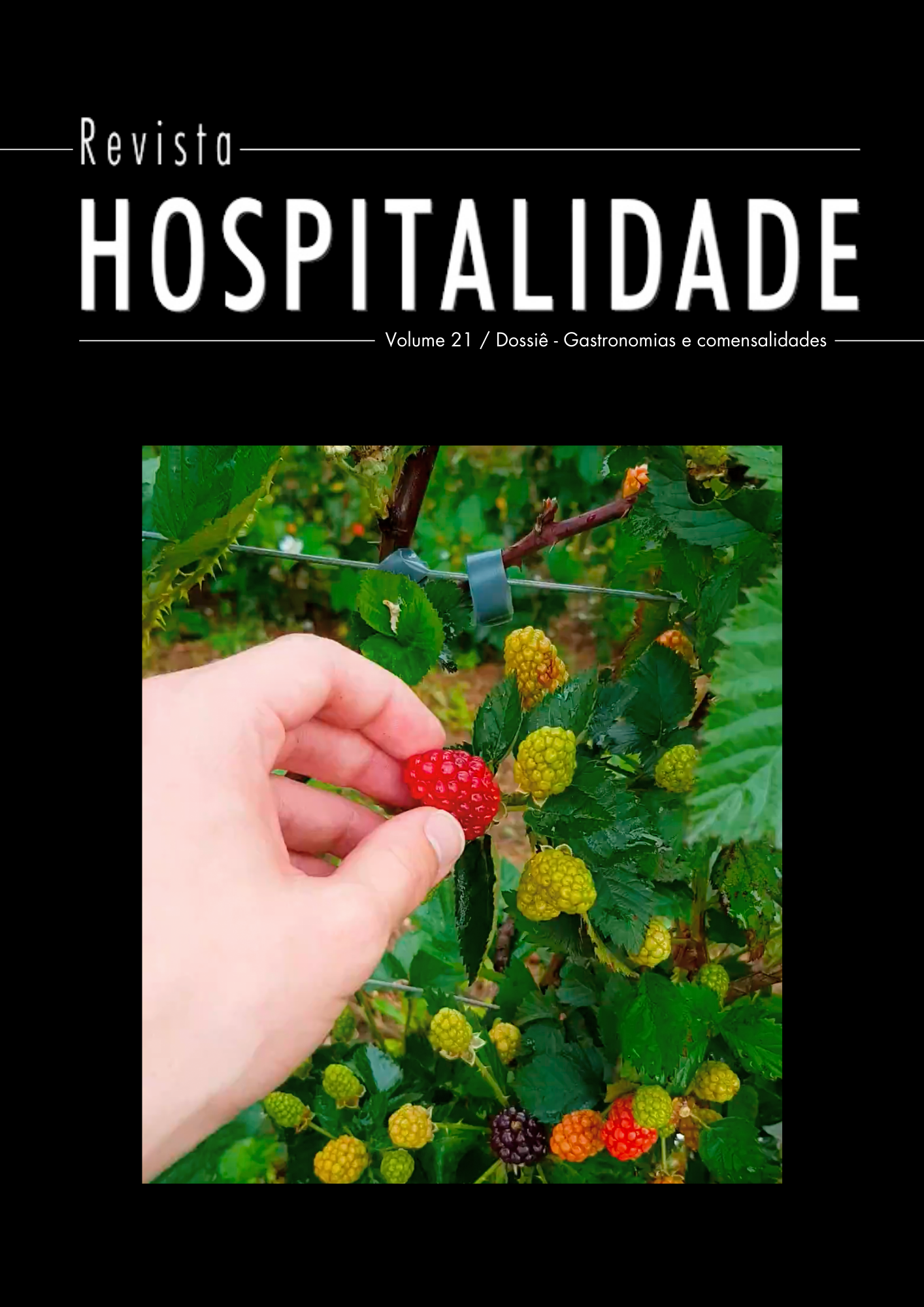
The intersection between tourism and agro-food heritage has received increasing attention in the fields of Gastronomy and commensality studies, being recognized as a relevant theme involving cultural, historical, environmental, and socioeconomic dimensions. These relationships can strengthen local identities, agrarian practices, and regional economies. However, the commodification of this heritage also presents challenges and contradictions. This work aims to analyze how the interaction between tourism and agro-food heritage contributes to constructing, preserving, and transforming territorial identities, considering commodification processes and their social, economic, and environmental implications. The study employs a critical and interdisciplinary literature review, exploring concepts of cultural tourism, sustainability, and food heritage. The results highlight tensions between cultural preservation and economic interests, demonstrating the need for public policies that balance development and community valorization. It is concluded that understanding these dynamics can generate broader and more grounded debates about food, identities, and economic exploitation in the contemporary context.
Downloads
References
ÁLVAREZ, M. Los recursos alimentarios entre la cultura y el turismo: poniendo em perspectiva las nuevas formas de intervención sobre el patrimônio. In: TRESSERRAS, J.; MEDINA, X. (Eds.). Patrimonio gastronómico y turismo cultural en el mediterráneo. Barcelona: IBERTUR, 2007, p. 95-123.
ARÉVALO, J. La tradición, el patrimonio y la identidad. Revista de Estudios Extremeños, v. 60, n. 3, p. 925-956, 2004.
ALVAREZ, M.; MEDINA, F. X. Identidades en el plato. Barcelona: Icaria, 2008.
BAUMAN, Z. Modernidade líquida. Rio de Janeiro: Zahar, 2001.
BENJAMIN, W. Magia e técnica, arte e política: ensaios sobre literatura e história da cultura.
ed. São Paulo: Brasiliense, 1994.
BESSIÈRE, J.; POULAIN, J-P.; TIBÈRE, L. L’alimentation au cœur du voyage. Le rôle du tourisme dans la valorisation des patrimoines alimentaires locaux. Mondes du tourisme, n. 71, p. 71-82, 2013.
BOUAZZOUNI, N. Fominismo. Belo Horizonte: Quintal Edições, 2019.
BRASIL. Ministério do Turismo. Gosto pelo Brasil: Programa Nacional de Turismo Gastronômico. Brasília: Ministério do Turismo, 2022. Disponível em: https://www.gov.br/turismo/pt-br/acesso-a-informacao/acoes-e-programas/programa-nacional-de-turismo-gastronomico/CartilhaGostopeloBrasil2022.pdf. Acesso em 8 nov. 2024.
BRULORRE, R. L.; GIOVINI, M. A. Edible identities: food as culturais heritage. London: Ashgate Publishing, 2014.
CONCEIÇÃO, V. S.; ROCHA, A. M.; SILVA, M. S. Indicação geográfica para o dendê da Bahia: uma possibilidade. Cadernos de Prospecção, v. 14, n. 2, p. 648-663, jun. 2021. DOI: https://doi.org/10.9771/cp.v14i2.33014
CONTRERAS, J. GRACIA, M. Alimentação, sociedade e cultura. Rio de Janeiro: Fiocruz, 2011.
CORONA, S.; SUREMAIN, C. Patrimonios alimentarios. México: El Colegio de San Luis, 2019.
CSERGO, J. A emergência das cozinhas regionais. In: FLANDRIN, J. L.; MONTANARI, M. História da alimentação. São Paulo: Estação Liberdade, 1998, p. 614-628.
CSERGO, J. Quelques enjeux de l’inscription de patrimoines alimentaires à l’Unesco. Géoéconomie, v. 78, n. 1, p. 187-208, 2016a. DOI: https://doi.org/10.3917/geoec.078.0187
CSERGO, J. La gastronomie est-elle une marchandise culturelle comme les autres? La gastronomie française à l’UNESCO: Histoire et enjeux. Chartres: Menu Fretin, 2016b.
DAGNINO, R. Tecnologia social: contribuições conceiturais e metodológicvas. Campina Grande: EDUEPB; Florianópolis: Insular, 2014. DOI: https://doi.org/10.7476/9788578793272
DELEUZE, G.; GUATTARI, F. Mil platôs, v.1. 2. ed. São Paulo: Editora 34, 2011.
ESPEITX, E. Los espacios turísticos del patrimonio alimentario. In: TRESSERRAS, J.; MEDINA, X. (Eds.). Patrimonio gastronómico y turismo cultural en el mediterráneo. Barcelona: IBERTUR, 2007, p. 153-174.
FACHINI, C.; MORENO-ROJAS, R.; CARVALHO, A. Mudanças climáticas e patrimônio agroalimentar: aprendizados para resiliência. PerCursos, v. 22, n.49, p. 198-225, 2021. DOI: https://doi.org/10.5965/1984724622492021198
FERRO, R. (Org.). Pensando e pesquisando a gastronomia: trajetórias acadêmicas em um campo científico em construção. Curitiba: CRV, 2021. DOI: https://doi.org/10.24824/978652511821.5
FLANDRIN, J. P.; MONTANARI, M. História da alimentação. São Paulo: Estação Liberdade, 1998.
GONZÁLEZ, P. A. O antipatrimónio: fetichismo do passado e dominação do presente. Lisboa: Imprensa de Ciências Sociais, 2019.
GYIMÓTHY, S.; MYKLETUN, R. J. Scary food: commodifying culinary heritage as meal adventures in tourism. Journal of Vacation Marketing, v. 15, n. 3, p. 259-273. DOI: https://doi.org/10.1177/1356766709104271
HARVEY, D. (1990). The condition of postmodernity: an enquiry into the origins of cultural change. Oxford: Blackwell.
HARVEY, D. The “new” imperialism: accumulation by dispossession. In: PANITCH, L.; LEYS C. (Eds). The New Imperial Challenge. Socialist Register 40. London: The Merlin Press. p. 63-87, 2004.
HEINRICH, F. Crítica da experiência como mercadoria no campo do design. Tese (Doutorado em Artes e Design) – Pontifícia Universidade Católica do Rio de Janeiro, Departamento de Artes e Design, 2018.
HERNANDEZ, J. C.; SERRA, J. R. Are nutrients also good to think? Semiotica, v. 211, p. 139-163, 2016. DOI: https://doi.org/10.1515/sem-2016-0111
HOBSBAWM, E. J.; RANGER, T. (Orgs.). A invenção das tradições. 12. ed. Paz e Terra, 2012.
INSTITUTO CHICO MENDES DE CONSERVAÇÃO DA BIODIVERSIDADE. Manual Caiçara de ecoturismo de base comunitária: subsídios para planejar e implementar o ecoturismo em áreas protegidas e seu entorno. Brasília: ICMBio, 2021. Disponível em: https://www.icmbio.gov.br/cairucu/images/stories/downloads/manual-ecoturismo-comunitaria.pdf. Acesso em: 8 nov. 2024.
INSTITUTO do Patrimônio Histórico e Artístico Nacional (IPHAN-Brasil). Educação patrimonial: inventários participativos: manual de aplicação. Brasília-DF, 2016.
MARX, Karl. O Capital: crítica da Economia Política. Livro 1. São Paulo: Boitempo, 2013.
LANUZA, A.; FERNANDEZ, J. El impacto del turismo en los sitios patrimonio de la humanidad. Una revisión de las publicaciones científicas de la base de datos Scopus. Revista de Turismo y Patrimonio Cultural, v. 13, n. 5, p. 1247-1264, 2015. DOI: https://doi.org/10.25145/j.pasos.2015.13.084
LEFF, Enrique. Complexidade, racionalidade ambiental e diálogo de saberes. Educação & Realidade, v. 34, n. 3, p. 17-24, 2009.
LODY, R. O poder da comida: filosofia e antropologia da alimentação. São Paulo: Senac, 2024.
LONDOÑO, M. P. Estratègies de promoció gastronòmica associades al turisme en arees geograficament marginades. Via, v. 8, nov. 2015.
MACHADO, T. Um pé na cozinha: um olhar sócio-histórico para o trabalho das cozinheiras negras no Brasil. São Paulo: Fósforo, 2022.
MATTA, R. Posibilidades y límites del desarrollo en el patrimonio inmaterial. El caso de la cocina peruana. Apuntes: Revista de Estudios sobre Patrimonio Cultural-Journal of Cultural Heritage Studies, v. 24, n. 2, p. 196-207, 2011.
MATTA, R. Food incursions into global heritage: peruvian cuisine's slippery road to UNESCO. Social Anthropology/Anthropologie sociale, v. 24, n. 3, p. 338-352, 2016. DOI: https://doi.org/10.1111/1469-8676.12300
MERLO, P.; VIANA JUNIOR, F. S. C. Cozinha performática, identidade local e atrativo turístico: reflexões sobre as inter-relações entre turismo e gastronomia. In: GAZONI, J. et al. (Orgs.). Pesquisa em turismo: colaboração, inovação e interdisciplinaridade. Goiânia: Espaço Acadêmico, 2020, p. 516-539.
MIGUEL-MOLINA, B. et al. Intangible heritage and gastronomy: the impact of UNESCO gastronomy elements. Journal of Culinary Science & Technology, v. 14, n. 4, p. 293-310, 2016. DOI: https://doi.org/10.1080/15428052.2015.1129008
MILANO, C. Eran bichos de siete cabezas: una isla del Delta del Parnaíba (Brasil) en la mira de la promoción turística transnacional. Tese (Doctorado em Antropología Social y Cultural) – Departamento de Antropologia Social e Pré-história, Universidade Autônoma de Barcelona, 2015.
MONTANARI, M. Comida como cultura. São Paulo: Senac, 2008.
MCMICHAEL, P. Regimes alimentares e questões agrárias. São Paulo: Editora Unesp e Editorada UFRGS, 2016.
OLIVEIRA, T. O. Revalorização de alimentos símbolo de comunidades-território. Os casos do mel virgem de abelhas Pisilnekmej no território maseual (México) e do queijo Gamonéu de pastores de Picos de Europa (Espanha). Tese (Doutorado em Recursos Naturais e Gestão Sustentável) – Instituto de Sociologia e Estudos Campesinos, Universidad de Córdoba, Córdoba, 2023.
PLOEG, J.D.V. Camponeses e impérios alimentares: lutas por autonomia e sustentabilidade na era da globalização. Porto Alegre: UFRGS, 2016.
PRATS, L. Antropologia y património. Cataluña: Ariel, 1997.
SANTILLI, J. O reconhecimento de comidas, saberes e práticas alimentares como patrimônio cultural imaterial. Demetra, v. 10, n. 3, p. 585-606, 2015. DOI: https://doi.org/10.12957/demetra.2015.16054
SANTOS, L. A. S. O corpo, o comer e a comida: um estudo sobre as práticas corporais alimentares cotidianas a partir da cidade de Salvador. Salvador: EDUFBA, 2008. DOI: https://doi.org/10.7476/9788523211707.0006
SANTOS, M.; SOUZA, M. A.; SILVEIRA, M. L. Território: globalização e fragmentação. São Paulo: HUCITEC, 1998.
SOARES, Cláudia Mesquita Pinto. Gastronomias: cartografia da constituição de um campo teórico-acadêmico dos bacharelados em Universidades Federais no Brasil. 2004. Tese (Doutorado em Educação em Ciências e Saúde) – Instituto NUTES de Educação em Ciências e Saúde, Universidade Federal do Rio de Janeiro, Rio de Janeiro, 2023.
SOUSA JUNIOR, V. C. Na palma da minha mão: temas afrobrasileiros e questões contemporâneas. Salvador: EDUFBA, 2011.
TOLEDO, V. M.; BARRERA-BASSOLS, N. A memória biocultural: a importância ecológica das sabedorias tradicionais. São Paulo: Expressão Popular, 2015.
TRONCOSO, C. A.; ALMIRÓN, A. V. Turismo y patrimonio. hacia una relectura de sus relaciones. Aportes y transferencias, v. 9, n. 1, p. 56-74, 2005.
UNESCO. Convenção para a salvaguarda do patrimônio cultural imaterial de 2003. Paris: UNESCO, 2006.
ZOCCHI, D. M. et al. Recognising, safeguarding, and promoting food heritage: challenges and prospects for the future of sustainable food systems. Sustentability, v. 13, n. 9510, p. 1-21, 2021. DOI: https://doi.org/10.3390/su13179510
Downloads
Published
How to Cite
Issue
Section
License
I herewith declare that I authorize the publication of the enclosed paper by Revista Hospitalidade and it will be labeled as “Open Access” and licensed by the respective authors in accordance with the Creative Commons Attribution (CC-BY) license, without period limitation. The access to the paper will be open and free. access, for an indeterminate period and as unpaid and my collaboration is royalty-free. I declare also that this is an original work that has not been previously published, it has been written by the stated authors, and third-party sources were duly referenced when necessary. I further declare that this work does not infringe the copyright or property right of another and I am aware of publisher´s policy with regards to plagiarism, that will consist in immediate withdrawal of the article. Authors retain the copyright and grant the journal the right of publishing it as original work, i.e. guaranteeing that it has not been previously published, and now it is licensed under “Creative Commons Attribution” License which allows sharing the work with the condition of both authors and journal being duly referenced.